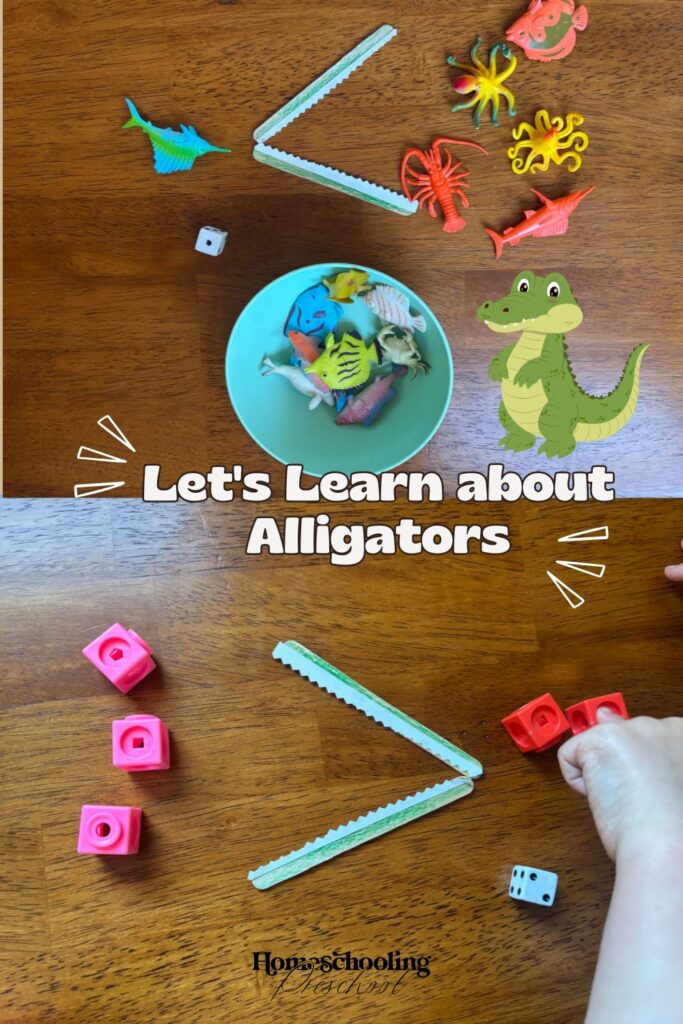
Let’s Learn About Alligators
Learn all about alligators with your preschooler with these fun ideas. There are ideas for sensory play, math, science, and much more!
Background about Alligators
Alligators are Reptiles
Reptiles are a group of animals that live both in the water and on land. They have scaly skin and are cold-blooded. They need the sun to warm their bodies. Alligators breathe air–like us!
Baby Alligators are Hatched Out of Eggs
Alligator eggs are hard, just like chicken eggs, when they are first laid. The eggshell gets soft and rubbery as the baby grows inside the egg.
The Mama alligator lays 30-45 eggs and guards their mud nest while incubating the eggs.
They Live in Warm Places
Because they are reptiles, alligators need to live where it is warm so their bodies stay warm.
They look for areas with water, such as marshes or swamps.
In the United States, such places include Florida and Louisiana.
Alligator Food
Alligators eat a range of food that they can get their chompers on—animals like birds, fish, turtles, and other animals. They are hunters, after all.

This article may contain affiliate links to products that may help you when homeschooling preschool.
Common Questions Kids Have about Alligators
Do mama alligators take care of their babies?
Yes! As soon as the mama alligator lays her eggs, she is on watch! She protects them while they are growing in their eggs.
After they hatch, the mom will carry the babies to the water and protect them there.
She will stay with the babies and care for them for about a year (sometimes longer).
Can alligators hurt me?
Any animal has the potential to hurt you. You must follow the safety rules that grown-ups and the zoo (or other similar places) have established.
If you see an alligator, be sure to give them lots of space.
Why do alligators have so many teeth?
Alligators need many teeth because they eat hard meat and bones. They need to be able to crack shells and bones.
Do alligators live with their families?
They live in groups of females and offspring, allowing them to look out for one another. Once the offspring reach two or three years of age, they leave the family and head out on their own to establish their territory.
Ideas for Teaching Kids about Alligators
Swamp Hop Activity
Use an item, such as construction paper or pillows, to create ‘lily pads’ on top of the swamp (the floor). Have your little one jump from lily pad to lily pad across the swamp while trying to avoid the imaginary alligators in the swamp.
Alligator Alphabet Match
Create cutouts of alligators and eggs (or print out clip art type pictures). Put uppercase letters on the alligators and lowercase letters on the eggs.
Let your little one work on matching the letters.
You can also hide the alligators around the house and make it into an alligator scavenger hunt.
A is for Alligator
Work on the letter A by doing this fun A is for Alligator printable craft (found in the Freebies Library).
Check out the post on how to do it here.
Painting with Alligator Skin
Using green paint and bubble wrap, create alligator skin prints. Encourage your little one to put green paint on the bubble wrap using a paintbrush, then stamp the bubble wrap around the paper.
This is a great way to sneak in fine motor skills by holding the paintbrush.
Salt Water vs Fresh Water Sink or Float
This is a fun twist on the traditional sink-or-float game. Create two containers of water. Add salt to one of the containers, using about 1 or 2 tablespoons per cup of water. To distinguish them, add food coloring to one of the containers.
Play “Sink or Float” by placing an item in the container and making a prediction about whether it will sink or float. After trying it in one of the containers. Dry it off and try it in the other container.
A carrot and an egg may be good examples to show that some sink in fresh water but float in salt water.
We have a post about sink or float if you are interested.
Swamp Sensory Bin
Create a swamp sensory bin using plastic alligators, sticks, and chia seed slime.
Read Books about Alligators
Books are a fun and cozy way to learn about new topics. Gather both fiction and nonfiction titles and curl up with your preschooler and enjoy the stories together.
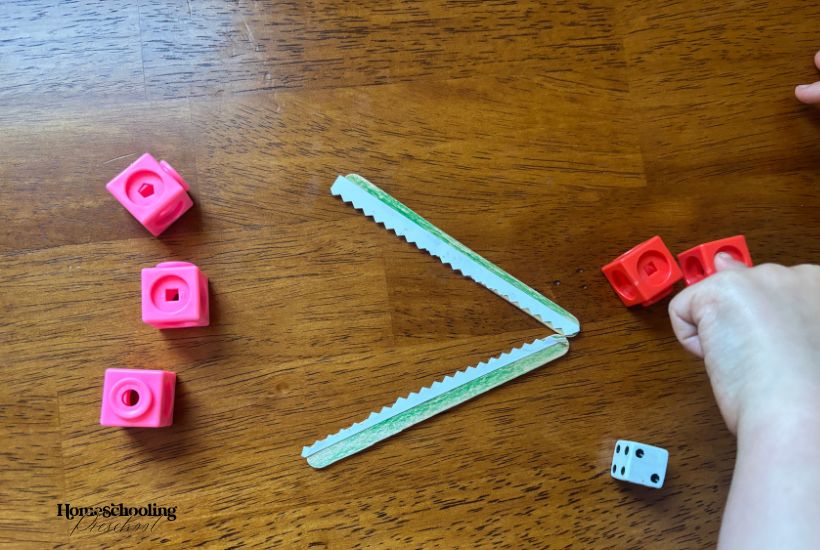
Greater Gator Math Activity
Item Needed
*craft sticks (or strips of green construction paper)
*green crayon (or marker)
*white paper
*scissors
*glue
*counters (or plastic fish)
*die
How To
1. Color one side of both of the craft sticks with a green crayon (or marker)
2. Cut out jagged-looking teeth from the white paper. If you have pinking shears, they work great.
3. Glue the teeth near the bottom edge of the craft sticks (or the strips of green construction paper).
4. Roll the die.
5. Count out the same number of counters that match the number on the die. Set these all in one group.
6. Roll again and repeat the process outlined in step 5.
7. Have your little one determine which group has more. They may need to count the items again.
8. Move the craft sticks to make a greater than or less than sign. It should resemble an open alligator mouth, chomping on a larger group of items.
9. Clear the groups, and repeat rolling the die, creating groups of counters, and having the alligator mouth eat the larger group.

Alligators for Preschoolers
Chomp around while learning through play with your preschooler. With little prep, these alligator ideas can come to life in your home.


