Let’s Learn about Money
Help money make cents (sense) 😉 to your preschooler with these fun teaching money ideas. There are games, books, and more!
Background about the US Dollars and Coins
While teaching money, take the time to explain the names of the bills and coins and let little ones look at and notice things about each.
Here is a bit of background to help you answer the million and one questions your little one might ask.
Bills
One Dollar Bill
The one dollar bill came about in 1862 and did NOT have good ol’ George Washington on it (it was the Secretary of Treasury Salmon Chase).
It wasn’t until 1869 that George Washington’s face was put on the one dollar bill.
When first created, the one-dollar bills were referred to as greenbacks (because they had greenbacks 😏), legal tenders, and United States Notes.
Since 1862, the United States Notes have undergone many redesigns. However, once the 1963 version came out, it stuck! The one-dollar bill hasn’t changed since 1963.
A few different seals (The Great Seal) are on the back of the one dollar bill.
Two Dollar Bill
The two-dollar bill came out in 1862, the same year as the one-dollar bill. It had Alexander Hamilton’s face plastered on the front. Why Alexander Hamilton? He was the first Secretary of the Treasury.
In 1869, Thomas Jefferson’s beaming face appeared on the front of a two-dollar bill. The back now has a painting of the Declaration of Independence on it.
Five Dollar Bill
The first US $5 bill was issued in 1914, featuring Abraham Lincoln on the front. The current $5 bill has the Lincoln Memorial on the back, along with many different security features to prevent counterfeiting.
Note to add: The Confederate States of America used five-dollar notes during the Civil War.
Ten Dollar Bill
The first $10 bill was made in 1914 and had Andrew Jackson’s face on it.
Alexander Hamilton found his place to stay on the $10 bill. What’s unique about his picture is that he is facing right while all the other people on the bill face to the left.
Alexander Hamilton was not president, but he still found his way onto the $10 bill. He is one of two people emblazoned on money who weren’t presidents (Benjamin Franklin is the other).
On the back of the $10 bill is the US Treasury Building.
Twenty Dollar Bill
The $20 bill, issued in 1861, featured Grover Cleveland, a steam locomotive, and a steamship on the back.
Currently, it features the White House on the back and Andrew Jackson on the front.
Fifty Dollar Bill
President Grant was the first (and current) face of the $50 bill, which came out in 1914.
The back of the current $50 bill shows a picture of the US Capitol.
Hundred Dollar Bill
Another bill coming out in 1914 was the $100. It shows Benjamin Franklin, the other person who was never a US President. He is the only person shown on the $100 bill.
Independence Hall is on the back of the current $100 bill.
So why was Ben Franklin put on the $100 bill?
He was a founding father and made many notable contributions to American History and as a scientist and inventor.
Coins
Quarter
The quarter, made of silver, was introduced in 1796. In 1932, George Washington was added to the front of the quarter, and he is still on the quarter today.
Dime
The dime, also made of silver, was introduced in 1796. In 1945, after President Roosevelt’s death, his face was added to the front of the dime.
Nickel
The nickel came out in 1866, right after the Civil War ended.
There was a period when the half-dime and the nickel were both in the currency rotation.
The current nickel has Thomas Jefferson on it (and has since 1938).
Penny
The penny was the first coin produced by the US Mint. It was made of pure copper and issued in 1793.
The current penny features Abraham Lincoln. In 1909, when his picture was first put on the coin, he became the first real person to be put on a coin.
Common Questions Kids Have about Money
Why can’t we print more money?
If anyone could print off money, it wouldn’t be worth anything. Think about if you could print more money to cover the cost whenever you wanted to buy something. There would be so many dollar bills in rotation that they wouldn’t mean anything.
They would lose value. The fewer of something we have, the more it is worth. The same is true with money. There is only a certain amount of money in rotation on purpose.
Where does money come from?
Our bills are made at the US Bureau of Engraving and Printing, and the coins are made by the US Mint.
Money is often stored in banks, where people have bank accounts that track how much money each person has.
People can withdraw money and receive paper bills or use a debit card. Either way, the money will be deducted from their account.
Money needs to be earned by working or selling things.

This article may contain affiliate links to products that may help you when homeschooling preschool.
Why can’t we swipe your card to buy (fill in blank)?
When I swipe my card, the money is taken from my bank account. I have to earn the money before it is put into my account.
If I tried to swipe my card when there wasn’t enough money, the cashier would tell me I didn’t have enough money and wouldn’t let me take the item.
As a family, we choose how we spend our money. We have made it a priority to focus on (fill in the blank).
Each family gets to choose how they spend the money that is earned. No two families choose to spend money the same way, and that’s okay! When you are older, you can choose how you spend the money you earn.
Why do we need to make money?
We need money to buy things. There are many different ways to get money, but the way we (mom, dad, etc.) get money is by [fill in blank].
Ideas for Teaching Kids about Money
Pretend Store (or Restaurant)
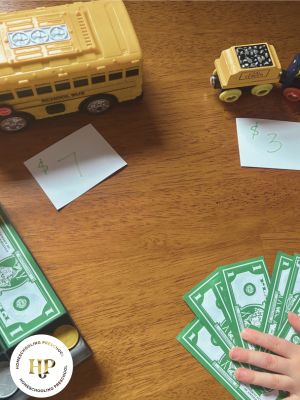
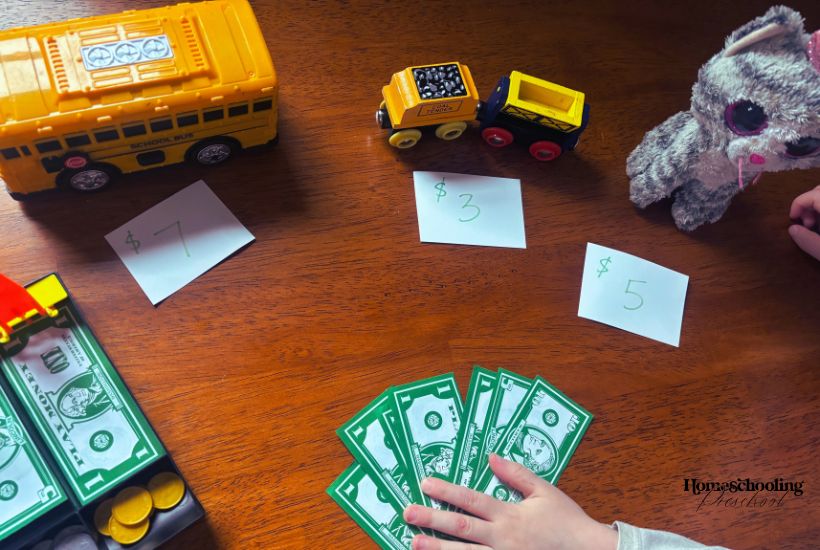
Gather some of your little one’s favorite toys. Use index cards or cut out squares of paper to write small amounts for each item’s worth. Place the card in front of the item like a price tag.
Let your little one choose an item to ‘buy’ and have them count out fake money to purchase it. This is one of my favorite ways to help little ones understand while I’m teaching money.
The same can be done by making a menu with prices and playing resturant.
Money Matching
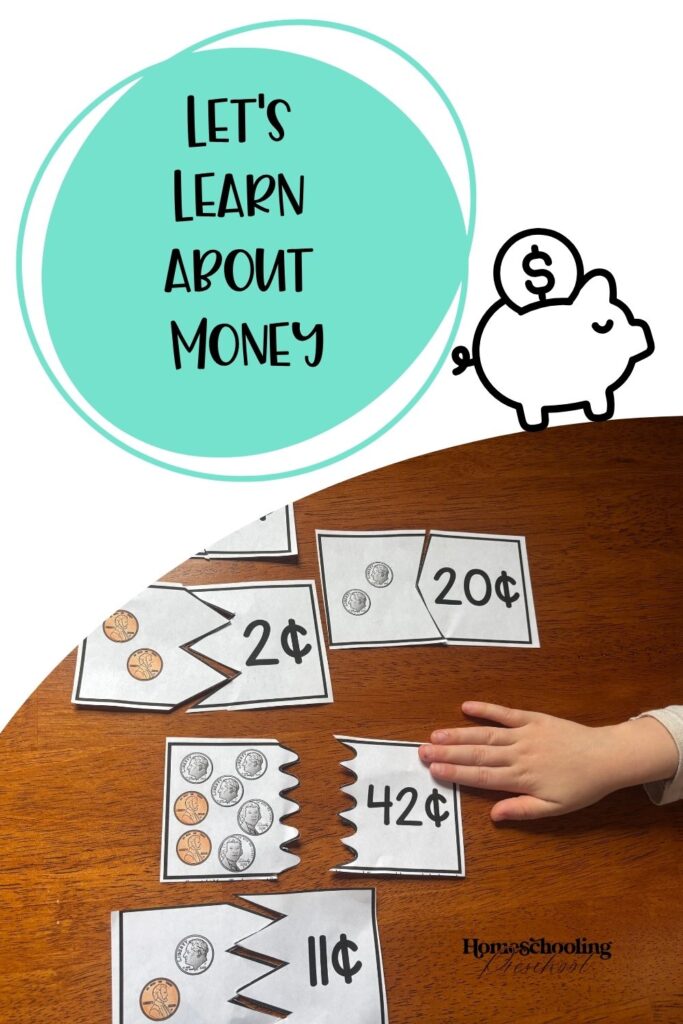
Print off a copy of this fun money counting and matching puzzle. The different line styles that connect the pieces make it perfect for preschoolers because there is automatic feedback. If it fits, it’s the right match.
Find it over on the Mama Teaches blog.
Coin Rubbing
Dump out the cup holder in your car and gather up those coins. Put the coins flat on the table. Some can be flipped so the heads are showing, and others can have tails showing. Place a sheet of paper over the coins.
Using a crayon with the label peeled off, hold the crayon parallel to the paper and rub it on top of the paper above the coins.
The design on the coins should show up on the paper.
DIY Piggy Bank
Use up some of your recyclables to make a piggy bank. For ideas and directions, check out our post about DIY piggy banks.
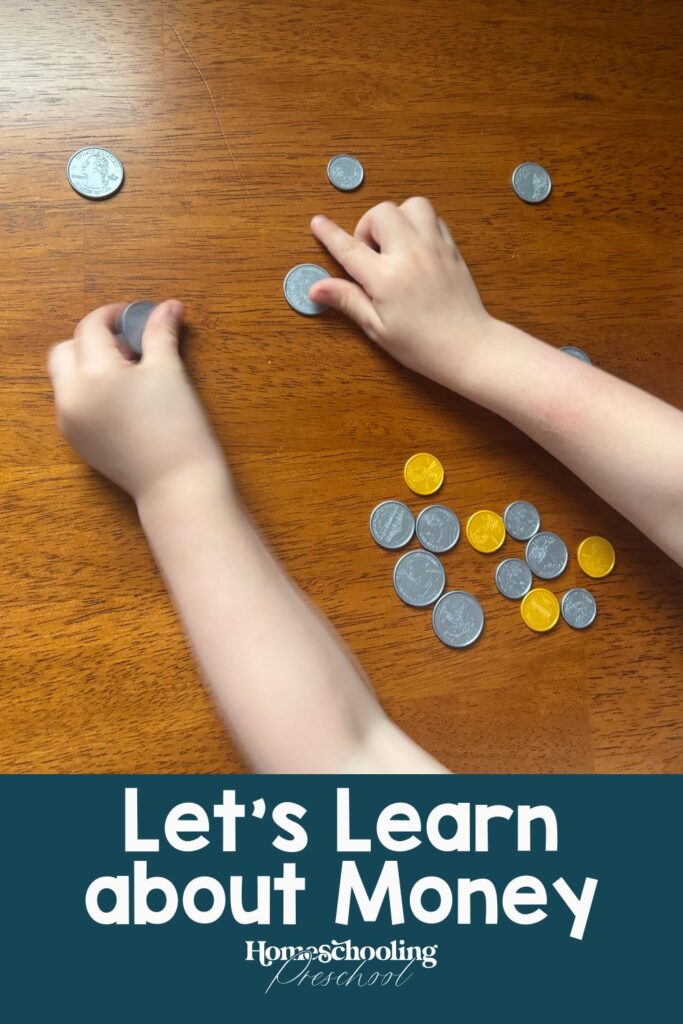
Coin Sorting
Collect various coins and put them into a pile. Pick out one of each type of coin and place it in its own pile.
Have your preschooler sort the pile of coins into the correct coin piles.
Teaching Money Songs
Music is gold for teaching money to preschoolers. The catchier the tune, the better.
Search for money songs to help teach coin names and denominations.
Read Money-Themed Books
Curl up together with books about money. We have a blog post all about money-themed books we hand-picked for you.
Check out the blog post here.
Weekly Ad Shopping
Preschoolers are drawn to the colors on the weekly sales flyers. Let them look at the numbers to see how much things cost.
If you are able, have them circle what they are interested in. Then, add up the cost of all of the items.
You can take them to the store and let them pick out some fruit and vegetables while keeping to a budget.
In an age of swiping plastic, periodically use paper bills so that little ones can see how money is exchanged for goods.
Teaching Money to Preschoolers
Get to teaching money to your preschooler with some fun and cheap games and activities. Thankfully, you don’t have to spend much money to teach about money and money sense (wouldn’t that be ironic).