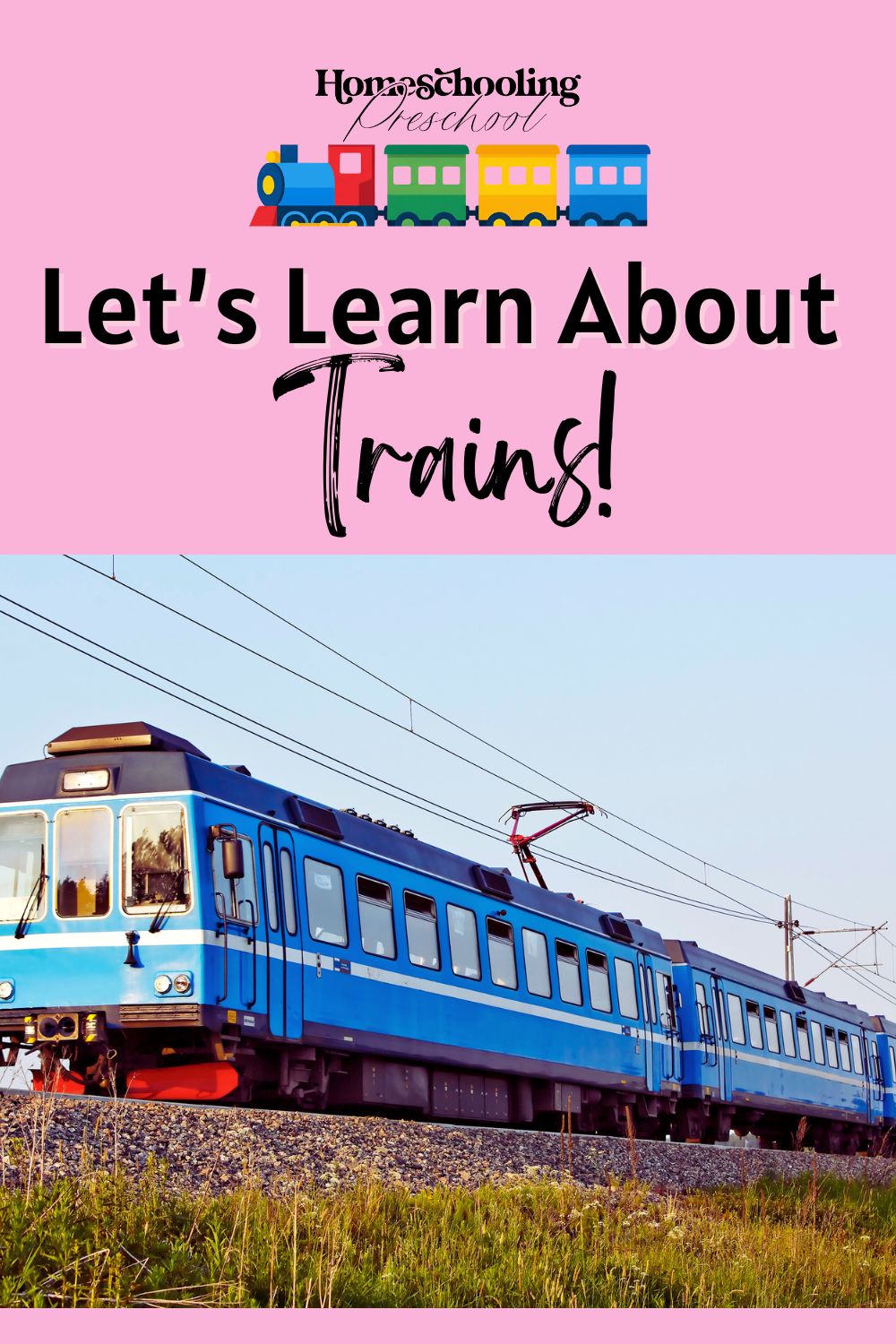
Let’s Learn About Trains
Chug along on a train theme with these hands-on train activities. Your preschooler is sure to have a blast learning all about trains.
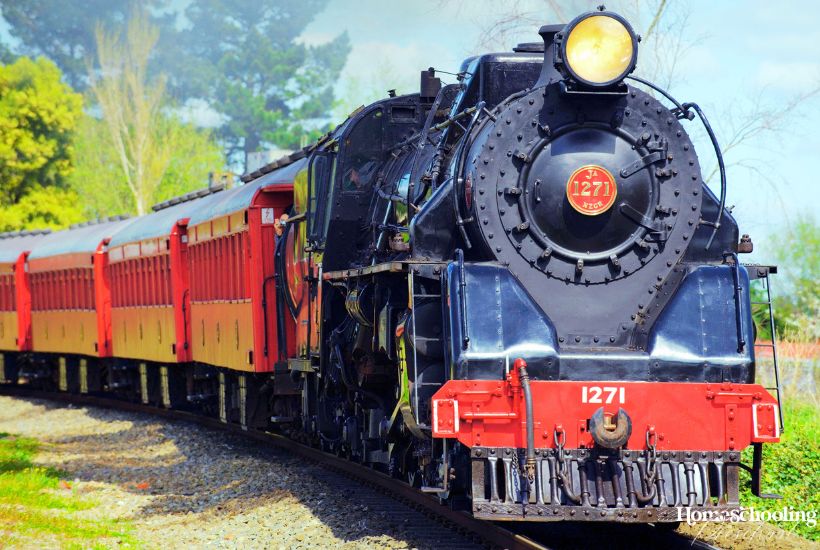
Different Types of Trains
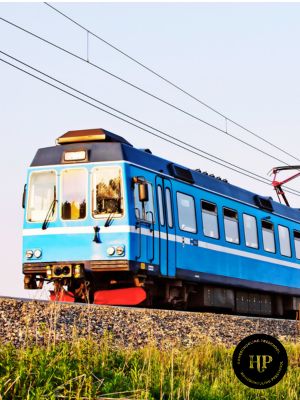
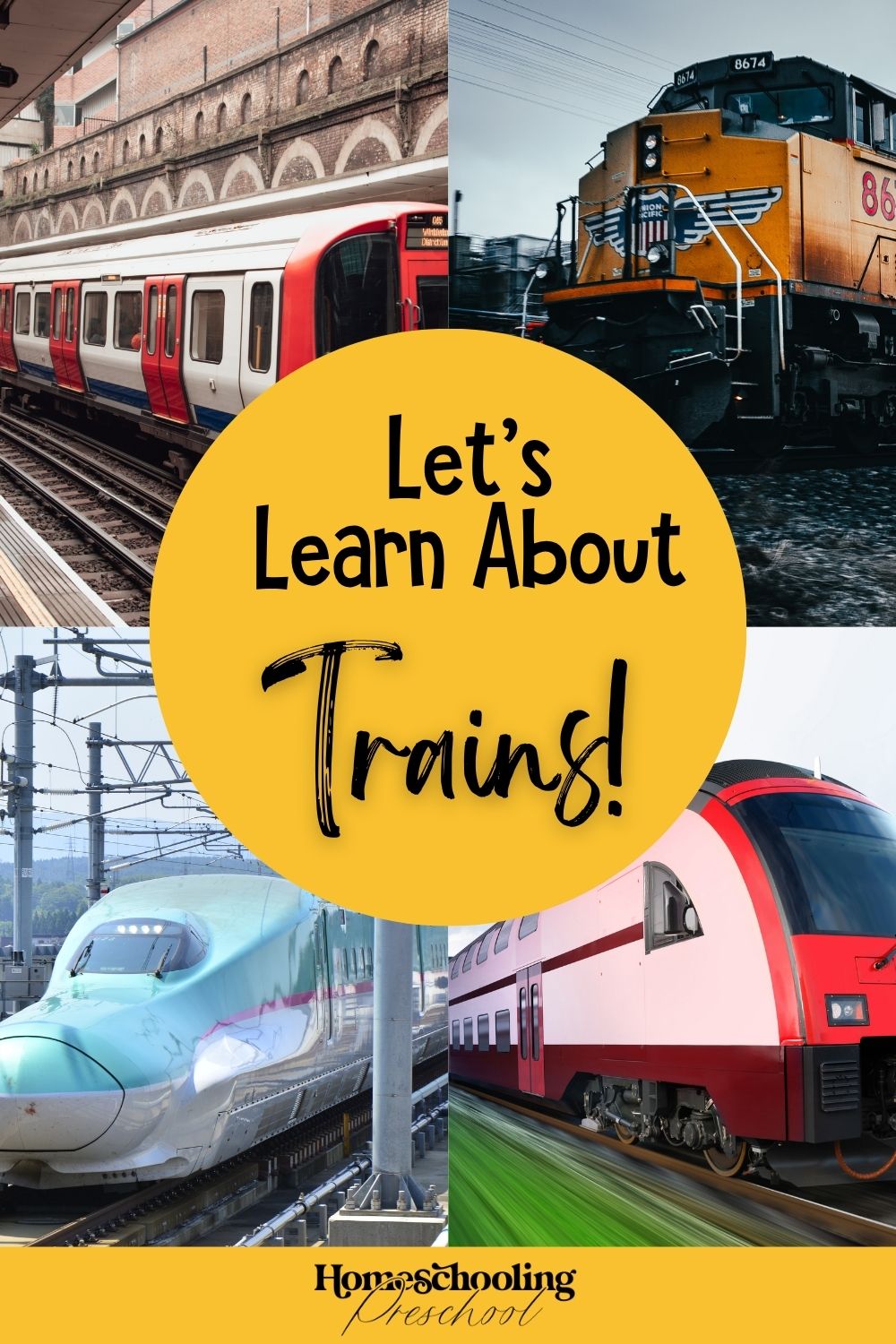
Passenger Trains
As the name implies, passenger trains carry people to different destinations. People use passenger trains when going from city to city.
Freight Trains
These trains carry goods, not people. They have one or more locomotives (engines) and many freight cars. They move items from the company shipping the items to the destination.
You may see logs, shipping containers, grain cars, or other specialized cars. The cars that are cylinder-shaped hold liquids or gases, while the rectangular prisms carry solid goods.
Subway Trains
Often found in the city, subway trains carry people. The stations can even be underground!
Subway trains are a way to get around within a city.
How Trains Move
Electric Trains
Trains that are powered by electricity
Steam Trains
Steam trains played a significant role in transforming America in its early years. Instead of relying on animals to pull them or travel by boat, steam trains provided a new way to travel and transport items.
Coal and wood are used to start a fire. The fire warms up water and creates steam. The steam pushes the piston, which then moves the train wheels.
Diesel Trains
These trains are powered by diesel and have engines similar to those found in cars.
Magnetic Trains
Magnetic trains, also known as maglev trains, can travel at extremely high speeds. They use magnetic forces to levitate the train cars off the track through repelling magnets.
This article may contain affiliate links to products that may help you when homeschooling preschool.
Common Questions Kids Have About Trains
Do trains have a driver who operates them?
Yes! Some important people work on trains. The train engineer controls the speed, braking, and the direction the train moves. It is also the train engineer’s job to inspect the train to ensure it is in working order before starting the train.
The train conductor is responsible for overseeing the passengers and cargo. This person will be responsible for coupling and uncoupling (connecting and disconnecting) the train cars.
How do trains stay on the tracks?
The shape of a train wheel is not circular. It is more cone-shaped. This wheel design helps the train to stay on the track and allows it to make the turns.
The weight of the train, pushing down on the wheels, also helps keep it on the track.
Why does a train ring the bell?
To keep people and animals safe, a train rings its bell when it approaches a train crossing. This tells people walking or driving cars that a train is coming and to clear the tracks.
It also scares deer, bunnies, and other creatures off the tracks.
Does riding a train feel like riding in a car?
Depending on how long your train ride is, riding in a train isn’t as bumpy. The subway may be a bit different because it has to stop often to let people on and off.
Similarly, when riding in a car, there is constant movement; the same applies to riding in a train.
Are there bathrooms on a train?
Most passenger trains have bathrooms on them. Subway trains do not because they are intended for traveling short distances.
Some passenger trains even have beds and showers!
Videos About Trains
Gecko And The Freight Train– Gecko’s Real Vehicles
Go along on a freight train adventure to learn about trains with Gecko.
It is filmed in Europe, so some of the words are slightly different from U.S. words (such as using the word’ wagons’ instead of ‘cars’).
Blippi Explores A Steam Train
Get up close and learn about steam trains with a character preschoolers love– Blippi!
How Does a Train Track Work?
Learn how train tracks work.
Invention of Trains– Dr. Binocs Show
Why were trains invented?
Ideas for Teaching Kids about Trains
Read Books about Trains
Gather a stack of books, both fiction and nonfiction, about trains. Books are a wonderful way to gather information about new topics.
By showing your preschooler that books are a wealth of knowledge, they will learn to look in books for information when they are older.
We have a post with books about transportation here.
Pretend Play Train
Use painter’s tape to create train tracks on the floor. Use a cardboard box or a laundry basket as a train engine. Add other boxes or baskets behind the ‘engine’ and fill with stuffies.
Little ones can also pretend they are the train without a box or basket. They can crawl or walk on the lines, trying not to fall off!
Name Train
Create a construction paper engine (see the last idea on this list). Then cut out different color squares to put behind the engine. Write one letter from your little one’s name on each of the colored squares.
Have your preschooler put the train cars together to form their name.
Red Light, Green Light
Get some gross motor (and listening) skills put to great use with this classic game. Have little ones pretend they are a train.
When someone says “red light,” they stop; when “green light” is said, little ones keep moving until red light is said once again.
Make it a bit more challenging by adding obstacles, such as things to navigate around or hills to climb.
Little ones will love being the caller, too!
Pattern Train
Use colored blocks to create patterns that follow a train engine (either a toy or construction paper works).
You can create pattern sheets on an index card for your little one to follow, or let them create their own patterns.
Recycled Materials Trains
Create your own train using items from your recycling bin. Boxes or egg cartons create the perfect engine body. Toilet paper or paper towel tubes can be used for the smoke or steam stack.
Use apple sauce pouch lids, milk jug tops, or other circular items to make the wheels.
Counting Cargo
Have little ones count the cars attached to the engine (either physical toy trains, if you have them, or block or construction paper cars).
Write numbers or put pieces of tape with numbers written on the cars. Encourage your little one to add the cars to the train in numerical order. Then have them drop off a certain number of cars, leaving three cars at this stop.
Your preschooler can continue to add and subtract train cars while they drive around the track.
Spatial Reasoning Track Building
If you have trains, let your preschooler try to build their track path. Not only will you be able to see them problem-solving, they will also need to reason if there is enough space for the track in the places they are trying to go.
Make a Shape Train Engine
Help little ones learn all about shapes with a shape train!
Cut out different shapes before starting the activity.
You will need:
*a big rectangle for the engine body
*square for the cab for the driver
*skinny rectangles for the smoke stack and top of the cab
*triangle for the front of the engine
*4 small circles for the wheels
Assemble the train by putting the big rectangle on the paper first. Then let your little one build the rest of the train engine using the shapes mentioned above. Use glue to attach the shapes to the paper.
While guiding your preschooler through the activity, use the shape and color to describe which piece to use.
Trains for Preschoolers
Discover trains in an engaging and hands-on way with your preschooler. These ideas are only the beginning when it comes to trains.